
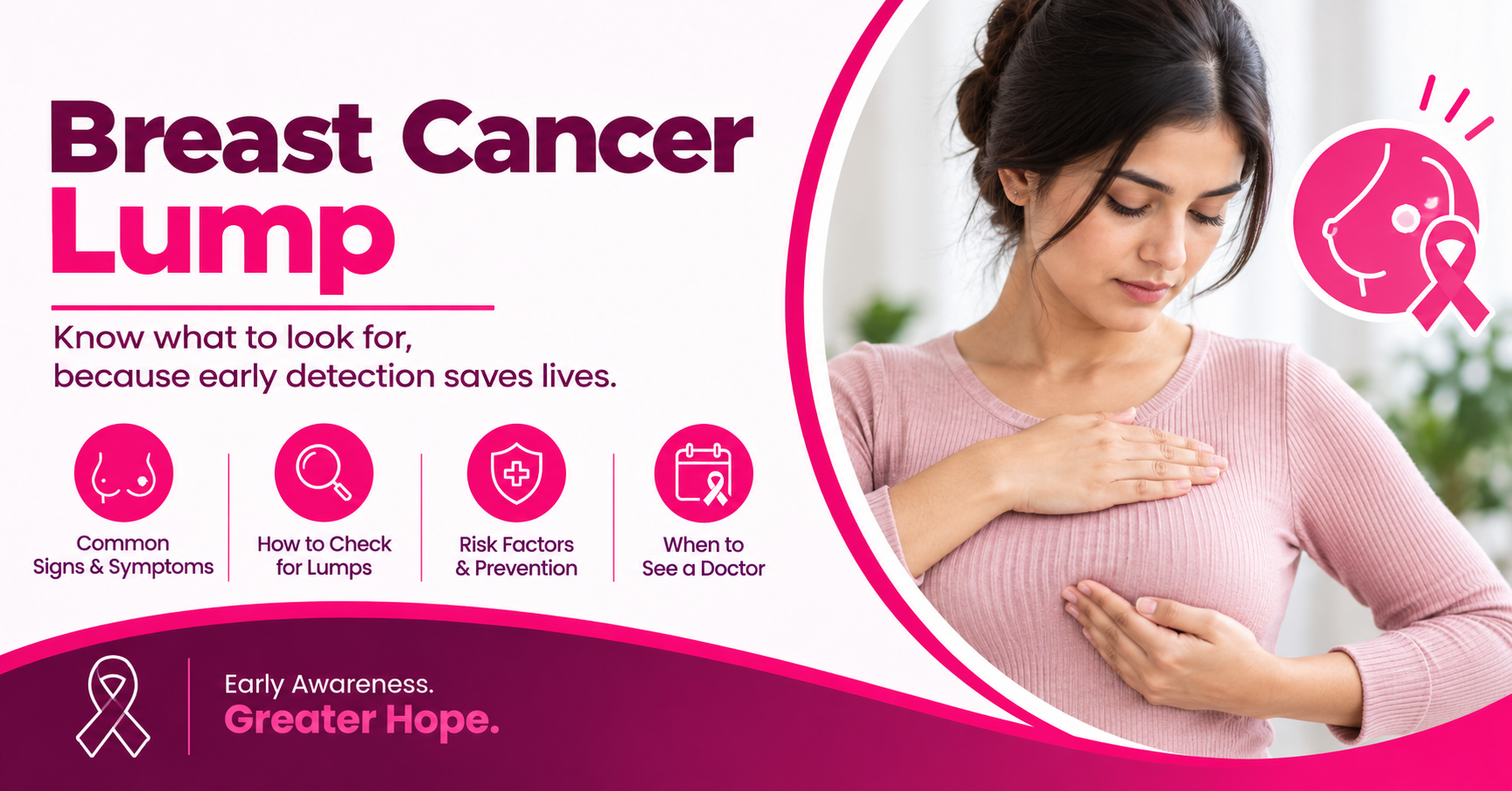
Have you found a new lump and felt your stomach drop? You are not overreacting. A breast cancer lump is a change in breast tissue that needs a medical check. But most breast lumps are not cancer. Some come from cysts, hormone changes, infection, or normal breast tissue.
This article explains what a lump feels like, why lumps happen, and when you should call a doctor. It also shows you how to check your breasts at home and where to find low-cost screening support.
What A Breast Cancer Lump Feels Like
A breast cancer lump will typically feel different than the rest of the breast. It will typically feel firm, har,d or bumpy. Lumps that are malignant (cancerous) can either be stationary or move around under the skin. A lump can also cause pain; however, this does not determine whether it is malignant or benign. The only way to find out if you have a malignant lump is to get a physical examination and imaging.
- Hard Mass: Cancerous masses are usually more rigid than surrounding breast tissue. They can also be irregular in shape, and they appear to be anchored.
- Any new lump, thickening of ski,n or swelling should be evaluated by a healthcare professional regardless of whether or not it causes pain.
- Skin changes: Puckering, dimpling, red color of skin and/or orange peel-like appearance of skin require immediate medical attention.
- Changes in your nipples (e.g., they turn inwards, bleed, scale) need to be evaluated by a healthcare provider.
- An armpit lump is another reason to seek medical attention. A new lump that forms either in your armpit or close to your collarbone can be serious because lymph nodes are located in both areas.
Why Breast Lumps Happen
There are many normal causes of lumps in the breast. These include different normal changes in a woman’s body related to various stages of her life, including hormonal changes, pregnancy,cy and breastfeeding. If you find a lump, you should see a clinician. Your clinician may order a mammogram, ultrasound, or perform a biopsy. Most lumps are benign (not cancer). If a lump is found, it is best to have it checked so that it can be medically cleared.
Hormonal Changes And Your Periods
Changes that happen in your breasts just before your period that cause tenderness and lumps usually go away after your period. Find and document any lumps that are present after your period, as they may be cause for concern. If a lump persists after your period, it is important that you see your clinician. Be sure to note any changes that the lump has undergone.
Cysts
A cyst is a sac that is filled with fluid. Cysts are non-cancerous. If a cyst is large enough, it may be felt and will feel much like a water balloon that is filled with fluid. An ultrasound will confirm the presence of a cyst and may also help the clinician drain the cyst if it is causing discomfort. This process is called aspiration.
Fibroadenomas
Fibroadenomas are also not cancerous and may feel much like a cyst; however, a fibroadenoma is a solid mass. Similar to a cyst, a fibroadenoma may also be documented on a mammogram.
Common Places And Types Of Lumps
Lumps can develop in many different locations within the body. Some are found deep within breast tissue, while others can be found near the nipple or even under an arm. While location alone cannot indicate whether a lump is dangerous, understanding typical locations of changes will allow you to provide a clear description of the change to your health care provider.
- Upper Inner Quadrant: This type of breast mass is located near the breast bone. If you notice a new mass in this location (no matter how large or small), report it immediately.
- Oval mass: Oval masses in the breast may be cysts or fibroadenomas. Imaging will help determine the shape of the mass, as well as the types of tissue present.
- Firm breast tissue: A firm breast may be normal for some individuals. However, a new firm area in one breast should be examined by a physician.
- When you have a lump in your breast while breastfeeding, it may be due to a blocked milk duct, swelling (engorgement), or an infection. However, if the lump does not go away, then you should have it checked out by your doctor.
- Lumps After Weaning: Milk production decreases after weaning. Therefore, lumps may develop within the breast during this time. However, if you find a lump several weeks later, consult with your doctor.
Nipple Bumps: Normal Or Not?
Many people notice small bumps on or around the nipple. This causes worry, but the answer depends on the type of bump. Some are normal glands. Others need medical care. Do not squeeze, pop, or scratch them. A clinician can tell the difference during a short exam.
Normal Nipple Glands
The nipple and areola contain small oil glands. These glands keep the skin soft and protected. They look like tiny raised dots. They are common and usually harmless. If they do not hurt, leak fluid,d or change quickly, they are often normal anatomy.
Bumps That Need A Check
A painful bump on the nipple, a growing bump, or a bump with discharge needs attention. So does an itchy lump on the nipple that does not heal. Redness, warmth, crusting, or bleeding also warrants a visit. These signs do not prove cancer, but they should not be ignored.
Bumps Around The Areola
Bumps around the nipple area can come from blocked glands, ingrown hairs,s or skin irritation. A weird bump on the areola that appears suddenly deserves a look. If you ask, “Why is my nipple bumpy?” the safest answer is to have a professional examine it once. That visit removes guesswork.
How To Check Your Breasts At Home
There are no special skills required for you to recognize when something has changed on your body. All that is needed is a set pattern of behavior. For example, check yourself at least once every month (ideally within 2-3 days of when your period ends). If you don’t have periods anymore, pick one day per month to perform this self-check. The best places to do these checks are in the shower, in front of a mirror, or lying down in your bed.
Look in the mirror and then raise your arms to see if there is any change in the appearance of your breasts (dimpling, redness, swelling, etc.) or if there have been changes to the nipples.
- Use flat fingers. Press gently in small circles across each breast.
- Cover every area. Go from collarbone to bra line and from armpit to breastbone.
- Check the armpits. Feel for new swelling or tender spots.
- Gently squeeze each nipple. Look for blood or unusual discharge.
- Repeat monthly. Learning your normal pattern makes new changes easier to spot.
A breast cancer mass does not have to be a specific type. It may be painful. It may be soft. It may be located close to the nipple. For these reasons, any new or lasting changes should be evaluated by a healthcare professional.
When To See A Doctor
See a clinician if a lump does not go away within a few days to a few weeks or if it occurs after a full menstrual cycle. Otherwise, if you notice any skin changes, nipple discharge, or a turn inward of the nipple, or a lump in your armpit, see a clinician immediately. There are many cases of early-stage breast cancer that occur with no symptoms of pain.
- Lumps that last more than 4 to 6 weeks need to be evaluated.
- Changes in size, texture, or other characteristics of a lump should be evaluated.
- If one of your breasts has a change, for example, a growth, and the other breast does not, this should also be evaluated.
- Nipple discharge, especially if it is bloody or clear fluid, should be evaluated.
- Other skin changes of the breast, like redness, painful irritation, or dimpling, should also be evaluated.
What Happens At The Appointment
The health care provider will ask you about when you first saw the lump, if the lump changes in size during your menstrual cycle, and they will check both of your breasts and your underarm areas. Depending on what is seen on the imaging tests (mammogram or ultrasound), your health care provider may recommend that you have a biopsy. A biopsy is a small amount of tissue removed from the area so that it can be tested.
Don’t panic about results. If you get a call-back from a mammogram, that doesn’t necessarily mean you have cancer. Oftentimes, a radiologist needs better quality images. When you go back to have those taken, bring any questions you have, document your symptoms, and ask for explanations that are written in simple terms. You have a right to know what’s going on at each stage of your treatment.
How EAESSI Can Help
EAESSI is a non-profit group that provides free breast cancer screenings to uninsured women between the ages of 39 and 64 living in northern Virginia. Since EAESSI pays for all of your screening costs, you will not have to worry about whether or not you can afford a screening. EAESSI can help you determine if you qualify for the program, assist with completing the application process,s and schedule an appointment at one of their partner clinics.
EAESSI also provides women with access to preventative healthcare services, private support,rt and guidance should they receive an abnormal test result. You do not need a referral from a physician to begin receiving help from EAESSI. If money was the reason why you had not previously scheduled a breast cancer screening, please call EAESSI at (706) 294-9100 or visit the Free Mammograms section of their website to apply.
Conclusion
New lumps in the breast should not be ignored. Most lumps are not cancer, but it’s important that you do not disregard them. To understand what is going on with your breasts, you should become familiar with your normal pattern and check monthly. If something changes, report it. EAESSI can assist women who are uninsured and eligible to get a mammogram. Getting a mammogram is less threatening than worrying about an undiagnosed condition.
Frequently Asked Questions
How does a cancerous lump feel?
It often feels hard, firm, or irregular. It may feel fixed, but some cancerous lumps are soft, round or painful. Only testing can confirm the cause.
Are bumps on nipple normal?
Small oil glands on the nipple and areola are often normal. A painful, growing, itchy,y or leaking bump should be checked by a clinician.
What is a breast cyst?
A breast cyst is a fluid-filled sac in breast tissue. It is noncancerous and may feel round or soft. Doctors can confirm it with an ultrasound.
Can breast cysts rupture?
Yes, a cyst can rupture, though it is not common. You might feel sudden pain, swelling, or tenderness. Contact a clinician if symptoms are severe or do not settle.
How can you feel a lump in your breast?
Use the pads of your fingers. Move in small circles across the whole breast, armpit, and collarbone area. Check monthly so you learn your normal tissue pattern.